'All that glisters is not gold.'
Ah, thank you, Dad. Nice to see you're feeling better.
Update: Joe says that's Shakespeare.
Sunday, October 03, 2004
The Guardian parodies itself in its sports pages (what else is new?)
I’m sure Guardian-reading sports fans (an oxymoron?) are very grateful for this highly politicized report of an international soccer game.
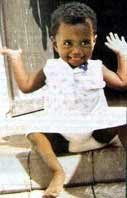
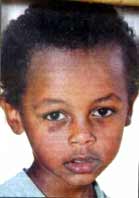
Scroll down to the photos of little Dorit and Yuval for balance.
Newcastle United fly out of Israel this morning having negotiated safe passage in a country where the phrase has connotations far beyond football.
On a day of extensive bloodshed 70 miles south of Tel Aviv, the Uefa Cup was of diminished importance, even to the minor miracle that is Bnei Sakhnin, but Newcastle still had a job to do.
[…]
As for Sakhnin, they and their 12,000 fans go back to the hills of Galilee and a life framed by violence. With no stadium and no money, theirs was a romantic tale of over-achievement, though the claims to Sakhnin demonstrating the power of Arab-Jew co-operation were left looking weak when the news came through shortly before kick-off that the Israeli military had killed 28 Palestinians near Gaza City.
The atmosphere was subdued and any chance that it might be aroused by Sakhnin staging one of the great upsets was removed when Kluivert collected a lovely back-heel from Jermaine Jenas and side-footed in the first.
Scroll down to the photos of little Dorit and Yuval for balance.
Saturday, October 02, 2004

Jerusalem Post: Footage shows terrorists using UN-marked vehicle.
Haaretz: IDF releases footage of militants loading rockets into 'UN' car.
Militants? MILITANTS?! Makes you wonder what side Haaretz is on.
Here is the Israel channel 1 newsreel during which this footage was aired. It’s the whole newsreel in Hebrew. Fast forward to minute 5:45 to view the relevant part. You’d better watch it soon, it probably won't stay there for long. Beats me why this isn’t on the IDF spokesman’s site.
What you will see are three short segments, filmed from an IDF drone. First you see ‘militants’ burying a bomb in the ground so if an IDF tank should come along they can blow it up. Next you see ‘militants’ loading a Kassam rocket into a UN vehicle. In the third segment you see ‘militants’ loading a Kassam rocket into a Palestinian Police vehicle. Then you see the vehicle driving along the road, and then you see it being blown to pieces by a missile launched from an IDF helicopter.
Here are two year old Dorit and four year old Yuval, may they rest in peace, the babes killed as they played by their home in Sderot last week, by one of these Kassam rockets, launched by ‘militants’. Sderot is a town in pre-1967 Israel, not far from the border with Gaza.
 |
 |
Update: Here is the footage. It’s been edited differently than on last night’s channel 1 newsreel. First section, you see a Kassam rocket being launched. Second section, you see something being buried in the middle of the road, men standing around watching. Third section, you see men walking along a wall, one of them carrying something, then the men pass through a gate in the wall and load the thing onto a UN vehicle, and close the back doors.
I've seen it on TV a few times more. It is far clearer on TV, much better quality. It is quite clear that what the man is carrying and loading into the vehicle is a long metal tube.
Israel is demanding the resignation of Peter Hansen, the head of UNRWA, who is trying to wriggle out of it all by saying it couldn’t have been a Kassam rocket because “the object looks more like a folded-up stretcher than anything else. Especially since it was being carried with one hand. A Kassam rocket would be too heavy for a man to carry with one hand”. The Jerusalem Post points out that “According to the IDF website, the Kassam rocket is about 2 meters long and weighs on average 5.5 KG (about 12 pounds)”.
By the way, the car that was seen blowing up, on the channel 1 footage that I linked to before, was apparently unrelated to the police car shown just before.
Some things give you a jolt however often you see them.
I remember the first time I saw a number tattooed on someone’s arm. I must have been about ten. I was on the bus home from school, the number thirty-three.
She was sitting across from me, a large woman who seemed to me to be in her fifties, wearing a sleeveless cotton print dress. Little flowers, I think the pattern was, although the colors were faded from age and use. She had one of those awful pale green plastic baskets everyone used for carrying groceries from the store in those days. And there, on the inner side of her flabby white forearm was a little blue tattoo, a row of hardly distinguishable numbers.
I remember being surprised that the numbers were so blurred.
There were a lot of people with those tattoos back then. You don’t see them as often nowadays.
The Age of Tinsel
"A celebrity is a person who is well-known for their well-knownness".
Precious. Found link (sort of) in rebecca's pocket (what she’s reading).
What happens is this: An Israeli model gets a little part in a soap on cable. For about a week, she is happy just to manage to learn the lines reasonably well (thank God there are no three syllable words). Then things start getting frantic. She’s continually on the front pages of the newspapers and gets invited to all the best chat shows; thirteen year-old girls scream when they see her on the street and crowd around her for autographs. She soon comes to the realization that she is a very talented actress.
Now this is where she gets it wrong. Instead of continuing to milk the local cow till everyone is sick of her (including herself), she gets greedy. And so, off she trots to Hollywood to find fame and fortune. Being so wonderfully talented and beautiful, she must share herself with the rest of the world, it’s only fair.
But (gasp!) no one is waiting. After about three years of hustling, she gets a tiny part (‘woman in store’) in some obscure TV mini-series, by pulling every last string she has (it’s a Haim Saban production). No one ever actually gets to see it, but she is hailed all over Israeli media as an international star, as the one who finally made it. When she comes home for a visit, after yet another year of waiting tables, she appears on all the chat shows as ‘our very own success story in Hollywood’, and lands an advertising campaign, selling a new fad diet. Three years later she marries a rich American Jew in his seventies, thus managing to save face at home.
(Don’t try and work out who I’m talking about, I’m not. I just threw that together using details from the stories of various local egomaniacs, and not only female ones)
I have a new motto (translation from the Hebrew): ‘Not Everything That Sparkles Is Gold’.
I find it, along with ‘Istra Belagina Kish Kish Karya’, extremely consoling. Helps me handle the loud, shallow, lazy, silicone-and-buttox, stupidity-is-beautiful, atmosphere that has overrun a certain place where I am paid to spend a large part of every day.
***************
On the other hand, sometimes glitz is good. I really have to get one of those garish cycling t-shirts - all the better to SEE me with. Oh oh, I forgot to tell you the best news ever – Bish got a bike, just like mine (a Giant Sedona hybrid) but bigger. Thank you, R.T., for all your help. We’ve just got back from our first ride together. He’s all aches and pains, but he had a good time. I am suddenly aware of how very fit I am. Yippee.
Thursday, September 30, 2004
A few things
I told you Our Sis and Mister Our Sis visited the US, mainly New England, their first big trip without the kids, who are now nearly all grown-up. They spent Rosh Hashanna in a place called West Woodstock, Vermont, where they stumbled on Rosh Hashanna services in a beautiful reform shul in a converted barn (‘Not what you’d think. This was a lovely converted barn’). Used to Orthodox shuls, they said the service was strange but moving, and they enjoyed it. They were mainly excited about the very warm welcome they received from the congregation.
They said people were very warm to them, as Israelis, not only when they were among fellow Jews, but everywhere they went in America. Nice.
On the other hand, Our Sis told us that friends of theirs visited Europe. They weren’t received very nicely at all. At the border between, I think it was Italy and Germany, the German border police seriously hassled them, and Our Sis’s friend, the son of German immigrants, heard the policemen talking between themselves about giving these Jews a hard time. Jews not Israelis, note. The kids were apparently terrified by the unpleasant event and the family cut short their visit to Germany.
On another front, the situation in Sderot has been going from bad to worse. Increasing numbers of Kassam rockets, launched daily from Gaza on this southern development town in pre-1967 Israel, do not bode well for life after the disengagement, when the Palestinians in Gaza will be free to do as they like. Yesterday two little children were killed in Sderot by Kassam rockets.
Wednesday, September 29, 2004
Sunday, September 26, 2004
So why fast if one does not attach deep religious meaning to the act, if one does not ‘do it properly’?
I once heard a Jewish woman say that when she lit the Shabbat candles every Friday night she felt a connection to all Jewish women everywhere who were also lighting Shabbat candles, ushering in the Shabbat. And she also felt a connection to all Jewish women down the generations before her who had lit the Shabbat candles, and the yet unborn baby girls who would be lighting them in the future.
Fasting on Yom Kippur is also something we do and have been doing for many generations. This is a humbling thought. The essence of this fast, of this day, is also humbling. We beat our breasts as we collectively speak our transgressions, and together ask for forgiveness.
I haven’t been to shul on Yom Kippur for many years, so I haven’t actually done this for a while, but I can still hear the tune “And for all these oh Lord of forgiveness: Forgive us, pardon us, grant us remission.” Nostalgia has made the memory far sweeter than reality ever was. I used to be bored out of my mind.
You sometimes hear people saying defensively, ‘I haven’t done anything wrong, so I don’t have to fast’. You smile to yourself, because you happen to know one ore two things about those particular people.
Others aren’t taking any chances. You can probably leave your door wide open in Tel Aviv on Yom Kippur. The thieves are all praying and beating their breasts. They know that what they do for a living is wrong. They also know that tomorrow they will continue were they left off. Today they pray desperately.
Yesterday, Yom Kippur, I rode my bike through the wonderfully empty streets of industrial South Tel Aviv, through the deserted alleyways of the flea market in Yaffo, touching something that isn’t there on the other days of the year, not even on Shabbat.
When I came home I drank, two cups after the first trip, three after the second, so as not to dehydrate. Mine wasn’t a very ‘kosher’ fast.
But today I feel cleansed, and not just physically. There is a strength to Yom Kippur, however you choose to spend it.
Bottom line: Why fast? I’m not sure, but it feels good.
Saturday, September 25, 2004
A reader’s interesting thoughts:
The issue of Jewish secularism vs. 'observancy' is one I've been intrigued by for quite a while. Every religion has its traditionalists and its secularists, but of course with Jews the meaning of it all is obscured to some extent by the tendency to equate
Jewish ethnicity and Jewish faith. (I just wrote that Israel is the most obvious example of this, but crossed it out because I realized it's not the same thing - just goes to show how difficult this concept can be at times.)
Is "Jewishness" only adherence to a religion? That would neglect an obvious Jewish secular culture. Is "Jewishness" an ethnicity that tends to practice a certain religion? That neglects the various faces and colors of practicing Jews around the world. Is
"Jewishness" a national identity, i.e. Israeli? To make it so would disenfranchise Israeli citizens who are non-Jews by religion or ethnicity. Is "Jewishness" simply an inherited culture? Possibly, but is that a strong enough word for it?
I wonder if the roots of this seeming dilemma might be found in European history, extending back at least to the Middle Ages, where Jews were segregated and
considered separate from the European Christian population as a "people apart", regardless of religious observance or native language or outward appearance - the latter of course tended to be regulated. If a group is seen as "different" for long
enough, perhaps the reason for that difference can begin to seem inherent, rather than attributable to a specific original cause such as religious difference.
As I said above, I find this very intriguing because I can't offhand think of another case where religion and ethnicity seem so blended in terms of identity, and
I'm not even sure that's as fair and accurate a description of "Jewishness" as it might seem at first glance.
If a Jew 'converts" - to Christianity, to Buddhism - is s/he still a Jew? If an Eskimo 'converts' – to Judaism - does s/he become a Jew? I suppose that Israel is the place that would bring these questions into highest relief.
Also interesting, the above-mentioned concept of "common culture" is generally accepted as the best available definition of "Arabness", although the parallel stops just about there, as Arabs practice a number of different religions in addition to being
composed of myriad ethnicities.
Irit Linor? In Haaretz?
How very droll.
Irit Linor is an Israeli writer. Bish knew her in university. She used to be known mainly as a very loud lefty feminist who wrote a witty and provocative column in I forget which newspaper, and was a regular commenter on TV and radio. She later amused many by changing her tune a bit, following her marriage to a hunky TV military correspondent. She has also published two very popular books of fiction. One of them was made into a feature film.
But she first really captured my heart when she sent a wonderfully eloquent and cutting letter to Haaretz in 2002, I think, canceling her subscription. The letter was bandied round the Internet, as was Haaretz’s response. I think the only ones who didn’t get to read it were the rest of Haaretz subscribers. Haaretz didn’t dare publish the letter. They were in the middle of a mass reader exodus at the time, as a result of a severe clash between their open political stand and reality, as perceived by many of their veteran readers (including this one), and were reportedly getting a bit hysterical (not enough to change their stand but enough for them to be very worried).
And now she’s back, writing an article for Haaretz. As always, it’s worth reading. I see her as a representative of people like me, lefties whose eyes were forced opened in September 2000 and after.
Friday, September 24, 2004
More on being a secular Jew
(This post may be a bit shocking for traditional and religious Jews, who may have certain pre-conceptions about life in Israel. Be warned)
A reader suggested it must be difficult to be a secular Jew in Israel. On the contrary, Israel is an excellent place to be secular. First of all, the majority of Jewish Israelis are either secular or traditional.
The modern State of Israel was created by secular socialists, breaking out of the confines of Eastern European yeshivas. As a result, until fairly recently, the academic, financial, cultural, and political elites were mainly secular. This is changing, but even though the ultra-Secular tend to feel threatened by religious politicians attempting to infringe on their freedoms, it isn’t really happening (this is a bit complex – more about it another time, maybe).
Jews who came here from Arab and Muslim countries, by the way, make up about half of Israelis. They apparently lived a far less confining and restrictive style of Jewish life in their countries of origin than did the Jews in Eastern Europe, therefore when they came to Israel, many, if not most, became secular but remained traditional.
Secondly, in Israel the likelihood of your kids marrying non-Jewish people, if this holds any importance for you, is relatively low, even if you make no attempt to live any sort of ‘Jewish’ life.
Third, and best of all, if you are seriously secular, you get to make the most of both worlds on Yom Kippur.
Imagine, if you will, the busiest, noisiest, most congested street you know; always jammed with cars, buses, trucks whizzing past, horns peeping, hundreds of people filling the sidewalks, rushing this way and that.
And now try to mentally visualize that same street, completely empty, eerily silent. No vehicles moving on it, not even one, sidewalks empty of passersby, besides maybe the occasional family, walking slowly and reverently towards their synagogue.
And then you hear it, a low clicking, whirling sound. Soon there is a sight to go with the sound, a solitary guy on a bike, riding boldly, right in the middle of the wrong side of the road. He’s soon followed by a group of kids in their early teens, about six of them, racing their bikes, shouting out to each other. Next to go passed - a couple on roller blades, holding hands; and then more bikers, mainly children of various ages, many in packs, but quite a few serious adult bikers too, with all the fancy gear.
This is Tel Aviv on Yom Kippur, the best place to be in the world if you are a secular kid and you possess a bicycle. There is nowhere you can’t go, complete and utter freedom, unheard of, unthinkable. The next day the gangs of kids tell stories of how they reached as far as Herzliya and Rishpon in the north. An all time favorite is the Ayalon Freeway, which cuts through the east of Tel Aviv all along. For secular Tel Aviv kids, used to the restrictions of living in the middle of a busy city with all its dangers, Yom Kippur is a day of breaking free, a day of personal independence.
Last time I rode a bike in Tel Aviv on Yom Kippur was two or three years ago, and I think I was fasting (poor R.T., I more or less destroyed his bike on that occasion, but that’s another story). I’m going to try for both this year as well. Maybe I’ll drink water. Yediot Aharonot reported yesterday that 22.5% of the customers of one movie rental chain fast and watch movies. I wonder how many fast and ride their bikes!
So this morning was bike maintenance time. I’ve ridden with the girls a few times recently, so their bikes were fine, only needed a bit of air, and I fitted them with the lights I had bought, ready for the ritual Kol Nidrei night ride. Mine had another flat, on the other hand, so now we’re a bit low on spare inner tubes should we have any calamities (Erev Yom Kippur is not a good time to go anywhere near any bike shops - too packed).
Both girls have big plans and were on the phone all morning. I think Youngest is being a bit over-ambitious, her bike isn’t marvelous and she isn’t very strong, but now that I have my own bike, I’ll have no problem to come and save her, wherever she may find herself.
******************
So there we are. Yesterday I was proud to receive my first sample of hate mail, from someone who completely misunderstood an old post of mine so much so that he actually understood it to mean the exact opposite (he obviously didn’t read it very carefully). The e-mail itself was very silly. Besides one unpleasant expression which was repeated throughout (the ‘f’ word and the ‘sh’ word) to describe me, I am apparently in possession of a ‘little graphomaniac blabber's mind’. I quite liked that. Maybe I’ll make it my blog description.
I’ve deleted the old post. It wasn’t that important. And although you had to be pretty dense to be offended by the particular detail that made my hate-filled correspondent froth at the mouth, I really don't want to upset anyone like that. It’s so sad that people are reduced to such language and such behavior. If he had written a polite e-mail saying that he was offended by it, I would have apologized and deleted it, so why the violence?
Update: Good description of Yom Kippur by Shai.
Wednesday, September 22, 2004
I’m not sure why, but I love this:
Be virtuous, and find yourselves a dragonslayer.
Via Alice in Texas (‘Is that a gun in my pocket, or is that a gun in my pocket?’).
Bish would probably say it was shtooyot*. Still, he didn't marry a cheerleader, did he?
And while we're on the subject, Mazal Tov to David and Zahava, my nominees for Nicest Couple of the Blogosphere (MidEast Chapter), on the occasion of their wedding anniversary.
===================
*Shtooyot = nonsense
Another thought: I'm reading Alice and I'm thinking 'This must be the most un-cool, nerdy thing I have ever read in my life'. "The truth is that goodness is never boring, because it is creative and powerful and principled". You can't get more nerdy than that. Thing is, it's true, even if it does seem so unworldly and old-fashioned.
When did we become so cynical, so self-destructively sophisticated, that we automatically ridicule such sentiments, even as we see the wisdom in them? (Maybe because there aren't enough Darcy's to go round).
It's all Heathcliff's fault. The original incredibly-sexy-but-bad-news hero.
I confess, a long time ago I thought I was getting a Heathcliff, but he turned out to be a Darcy. No, even better than a Darcy. "Goodness is never boring, because it is creative and powerful and principled". Definitely. I am the luckiest person in the world.
Now see if you can beat that for uncool nerdy-ness, not to mention shameless mushy-ness.
More about why
Saw him being interviewed on channel 10 last night, such a nice, soft-spoken man.
Why would such a person put on underwear filled with explosives and come to blow up people?
Anger? Desperation?
According to the Jpost
A fight with the wife? Not exactly. Channel 10’s Zvi Yehezkeli said that al Razak's son had apparently committed some sort of morality offense, I think it was, and that this was a deal that they had offered him if he wanted to save his son. Charming people.
On TV last night, al Razak was asked what he thought about the people who had sent him. He said that there was a God in Heaven. The interviewer then said that those who sent him were claiming that they were doing God’s will. He was silent for a moment and then again said that there was a God in Heaven.
Since last night, I have been worried about what they might do to his son now. And if I’m worried, can you imagine how he must be feeling? Poor guy.
In an interview on Channel 10, Mohammed al Razak said he had been approached by Hamas terrorists in Gaza who asked him to carry out the attack and had received two payments of $200 but said he was not a member of the Hamas.
Razak - who lived for over thirty years in Jaffa and worked in Bat Yam, a Jaffa bakery and the central bus station in Tel Aviv - said that he was glad he had been caught, as he doubted he could have detonated the bomb when the time came.
Razak - who lived for over thirty years in Jaffa and worked in Bat Yam, a Jaffa bakery and the central bus station in Tel Aviv - said that he was glad he had been caught, as he doubted he could have detonated the bomb when the time came.
Why would such a person put on underwear filled with explosives and come to blow up people?
Anger? Desperation?
According to the Jpost
He refused to divulge the reason why he agreed to go ahead with the plan but cited family reasons.
On TV last night, al Razak was asked what he thought about the people who had sent him. He said that there was a God in Heaven. The interviewer then said that those who sent him were claiming that they were doing God’s will. He was silent for a moment and then again said that there was a God in Heaven.
Since last night, I have been worried about what they might do to his son now. And if I’m worried, can you imagine how he must be feeling? Poor guy.
Monday, September 20, 2004
Just got back from a parents’ meeting at Eldest’s school. Her class is a mixture of children from the relatively wealthy north and the less affluent south of the city (I say ‘relatively’ because Our Sis has just come back from a trip to New England, full of stories of real affluence).
This year, the municipality cancelled the special bus the kids from the south get to school, for lack of funds. The school is located in the north, about ten minutes walk from our apartment. The kids from the south are now being given bus tickets and are expected to get the public transport. It takes some of them about an hour and a half to get to school, poor things. The school administration is trying to negotiate a deal with ‘Dan’, the local bus company, so that they will allocate a special bus for these kids. They’ll pay with the bus tickets they’ve been given, but the bus won’t stop at any of the bus stops on the way, and will reach the school much quicker. I hope this solution works out.
During the meeting, while parents from the south were understandably letting off steam on the subject, some character at the back of the class kept making wisecracks about the discrimination of the south. It was uncomfortable.
Parents’ meetings in Middle School are truly horrible. We don’t know any of the parents, even those we suspect are parents of Eldest’s friends, unlike in elementary school where quite a few of the parents were our friends, and we knew all the others as well. Not that the parents’ meetings weren’t horrible in elementary too, just less so.
Tonight we couldn’t get away fast enough, and we certainly didn’t stick around for the lecture about dealing with drug abuse among adolescents.
The drugs issue has been a big joke in our household ever since Eldest confessed that she was very worried about some research she had read about somewhere that apparently had found that kids from families who didn’t have regular family meals together were more likely to deteriorate to drug abuse. We’re not very hot on formal family meals during the week, although we do manage a few every weekend. Bish expressed the view that maybe some families who don’t have family meals together could possibly have one or two problems besides the meal factor, and that maybe the lack of family meals was more of a symptom than a cause. She accepted the sense in this, but now we can’t help feigning mock distress every now and again, about Eldest’s imminent deterioration.
Sunday, September 19, 2004
Once upon a time Imshin and Bish lived across the road from an ultra-Orthodox boys’ school and synagogue. Every morning Imshin would encounter the resident rabbi as she left home for work and as he arrived for the early morning prayers. Imshin was going through a pretty spiritual period at the time, so she thought maybe the rabbi was, like, her local spiritual leader. Once or twice she tried to catch the rabbi’s eye, to say good morning or nod. He usually ignored her. Sometimes he graced her with a hostile glare. ‘So much for a spiritual leader’, Imshin would think, as she hurried on her way down the road, away from the rabbi.
Her religious friend at work said to her, ‘What do you want? He’s just a rabbi. He learnt some stuff and passed an exam. It doesn’t automatically elevate him to greatness.’ Her religious friend told this story about a rabbi in Bnei Brak he had gone to when his parents were dying of cancer. That guy sounded elevated to Imshin, but not the neighborhood rabbi from across the road.
One evening the gabbai of the synagogue across the road got hold of Bish, who was coming home from work. The gabbai was missing someone for his minyan (the ten Jewish men necessary for the prayer), and he was out in the street trying to grab someone. ‘You don’t want me,’ Bish told the gabbai, ‘I don’t believe’. The gabbai retorted that there was no such thing as a non-believing Jew. Bish answered, ‘Behold, before you - a non-believing Jew!’
Now it is not strictly true that Bish is a non-believer. He just didn’t believe in what the gabbai and his rabbi had to offer, and he wasn’t prepared to be coerced into participating in their prayer.
For eleven years Imshin and Bish lived across the road from that school and synagogue. Every four years, sometimes more, they ventured into the school to cast their vote for the national elections, every four years they cast their vote there for the municipal elections.
But they never set foot in the synagogue.
Some people, whose knowledge and experience of life and society in Israel is twenty years out of date, say that secular Judaism in Israel has no future. Some people seem not to have a clue what secular Judaism in Israel is, as opposed to secular Judaism, say, in the United States. But they are quite sure that it has no future. Bish says, ‘Some people are quite right’. Bish doesn't see 'The Future' as a very important concept. It’s the Buddhist in him speaking. You see - it is various types of Buddhism that are popular among secular Jews in Israel, including those who have spent time in India, not Hinduism, along with other popular types of supermarket spiritualism, many of them leading back to Judaism, Orthodox or otherwise. But some people wouldn’t know that, however brilliant they may be, however convinced they are that they know everything.
Secular Judaism in Israel cannot be seen solely as a religious affiliation, if at all. It’s a coincidence of birth (or choice); it's a state of being; an identity. It’s who and what we are. It has no future? What does that mean? A lot of people around the world are saying that the United States of America have no future either. What does that mean?
Some people are too judgmental. At least we have that in common.
[No link. Some people I don't link to any more.]
Dad wanted to know what an epikorsit was. Well it's a Hebraized female version of apikorus, heretic. Although as Dad points out, you actually have to have been religious and to have opted out, to be an apikorus, and that hasn't happened to me, although Mum did schlep me to shul, to be bored silly, on a regular basis, when we were living in England, and I used to fast on Yom Kippur till I met Bish , who is a real apikorus.
Friday, September 17, 2004
Epikorsit log: Real life
Thirteen-year-old Eldest volunteered to help prepare food parcels for Tel Aviv’s needy before Rosh Hashanna. She said she had vaguely envisioned the work as involving sitting in the shade of a tree on a nice grassy spot with a few friends, passing along packages of biscuits, or something.
Reality, as always, was a little less idyllic. She found herself in a hot, smelly, dirty street, in an industrial area of South Tel Aviv, opening out seemingly endless amounts of cardboard boxes, and sorting crates of moldy vegetables. She worked very hard. She came home exhausted. I was so proud of her.
Epikorsit log: The perspective of the terrorist
Hadn’t had time to translate this, but I held on to it, because I think other people should get to read it. It’s from Yediot Aharonot 10th September, just a little corner frame at the end of an article in the weekend magazine, about a new book (Hebrew link) discussing the current war with the Palestinians. While the article puts an emphasis on the implications of the targeted killing of Raed Karmi in 2002, this little passage gives us an insight into what is going on in the heads of our enemies:
Hadn’t had time to translate this, but I held on to it, because I think other people should get to read it. It’s from Yediot Aharonot 10th September, just a little corner frame at the end of an article in the weekend magazine, about a new book (Hebrew link) discussing the current war with the Palestinians. While the article puts an emphasis on the implications of the targeted killing of Raed Karmi in 2002, this little passage gives us an insight into what is going on in the heads of our enemies:
The Head of the Hamas Prisoners: The Israeli Peace Camp pushed us to continue terrorist attacks.
“Your debate about the future of the settlements and their necessity in the territories just served to strengthen our resolve to continue with the terrorist attacks”, So says Sheikh Hassan Yussuf, head of the Hamas prisoners held in Israel, in a rare interview. Yussuf is regarded the head of the Hamas leadership in the West Bank and head of that organization’s West Bank political bureau. He was convicted of belonging to a terrorist organization.
The things that Yussuf said to the authors of “The Seventh War” (Hebrew link) will undoubtedly inflame many in Israel, but they expose something of the state of mind in Hamas. “The people of the Peace Camp in Israel”, he says, “those who spoke of ending the occupation and retreating, pushed us forward in our decision to continue with the suicide terrorist attacks. Ariel Sharon’s Gaza disengagement plan is also a great accomplishment that is a result of our activities. The refusenik phenomenon was the best evidence of the breakdown in Israeli society as a result of the suicide terrorist attacks. We thought that we should further deepen this breakdown and the use of the weapon of suicide became a matter of consensus in the organization”.
Another Hamas leader imprisoned in Israel, Jamal Abu Il-Hijra, who was the head of Hamas in Jenin and was arrested in August 2002 under suspicion of involvement in the suicide terrorist attacks in Meron junction, Matza restaurant in Haifa, and Sbarro Pizzeria in Jerusalem, also explains that the choice of suicide attacks was a combination of vengeful feelings with the wish “to change the perception of Israelis, who thought they could continue with the occupation indefinitely. The political negotiations didn’t bring forth any change. On the other hand, the terrorist attacks caused the Israelis to feel the pain we felt. We wanted them to pressure their government to stop its actions – and as far as we’re concerned the disengagement is proof that we have succeeded in changing the Israeli consciousness. More proof is to be found in statements of Israeli public figures, such as that if writer Batya Gur, who said that she understands the perpetrators of suicide terrorist attacks.”
Thursday, September 16, 2004
Epikorsit log: Listen to this, Shoosha - Someone comments on this Blog Full of Crap here that you are beautiful. I think someone needs their eyes examined. (We still love you though, especially since you haven't scratched us for about two weeks).
Eldest: 'Shoosha is beautiful'. Sorry, my mistake.
Eldest: 'Shoosha is beautiful'. Sorry, my mistake.